Hua
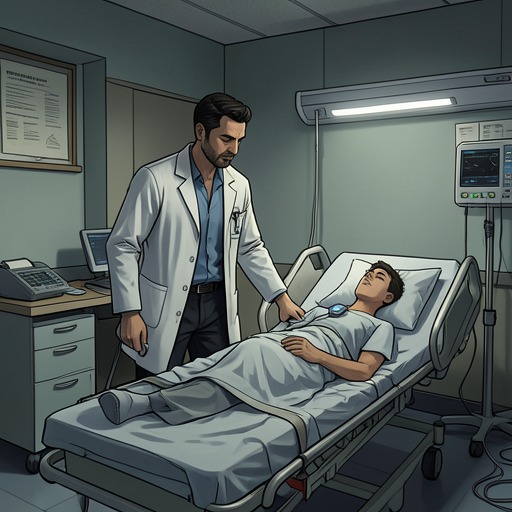
Station ElevenHua is a physician at Toronto General Hospital and Jeevan Chaudhary’s closest friend, though the two rarely see one another. During the first night of the Georgia Flu crisis, he calls Jeevan with news from the hospital: a rapidly spreading illness is filling its wards and killing patients. His warning marks the moment when an alarming report becomes a danger with a human voice, a specific hospital, and a friend who tells Jeevan to get out of the city.
Identity and Friendship
Hua and Jeevan first knew one another after university, when they tended bar together for a couple of years. Hua was studying for his MCAT; Jeevan was trying unsuccessfully to establish himself as a wedding photographer. Their paths then diverged: Jeevan followed another friend to Los Angeles to photograph actors, while Hua went to medical school. By the time of the novel’s opening crisis, Hua works long hours at Toronto General Hospital. Their friendship has endured despite their infrequent contact, and Jeevan regards Hua as his closest friend.
The history between them makes Hua’s call more than a medical update. Jeevan had previously asked him to call if there were ever a real epidemic. Hua remembers that request and acts on it when the situation at the hospital becomes unmistakably serious. His choice to contact Jeevan turns an old understanding between friends into an urgent practical warning.
The Hospital Call
Hua first asks whether Jeevan has been following the news. Jeevan has heard reports of a new flu in the Republic of Georgia, where accounts of mortality and the death toll remain conflicting and details are sketchy. The name Georgia Flu has struck him as almost disarmingly pretty. Hua’s account sharply changes the scale of that story: he has a sixteen-year-old patient in intensive care who flew in from Moscow the previous night, arrived at the emergency room with flu symptoms early that morning, and is not doing well. By midmorning, twelve more patients with the same symptoms have been admitted; all were on the same flight and say they became ill aboard the plane.
Hua’s first account already suggests how quickly the disease is moving, but his later call conveys the hospital’s accelerating crisis. More than two hundred flu patients have been admitted since morning, including 160 in the previous three hours; fifteen have died. The emergency room is full, beds have been placed in hallways, and Health Canada is about to make an announcement. The narration registers not only Hua’s exhaustion but his fear, distinguishing the call from routine professional news.
Warning and Narrative Role
Hua tells Jeevan that he must get out of the city. When Jeevan asks what is happening, Hua acknowledges that he does not know beyond the fact that it is a flu: he has never seen anything like it, and it seems to spread with extraordinary speed. The warning is therefore both decisive and limited. Hua cannot explain the outbreak or predict its course, but his direct experience gives him grounds to tell his friend to leave.
The scene sets the uncertainty of the wider crisis against concrete evidence accumulating at one hospital: a flight-linked cluster, a crowded emergency room, deaths, and beds in the hallways. Hua does not appear as an all-knowing guide to the pandemic; his importance lies in being close enough to its first visible surge to recognize that Jeevan should take it seriously. Through their friendship, the outbreak reaches Jeevan not as an abstract headline but as a warning from someone whose judgment he trusts.